Alzheimer’s Requires Putting Feet on Our Prayers
By Rev. Dr. Jim Thurman
Growing up in the 1950s and 60s, it was normal to come across older neighbors who would repeat the same questions, tell the same stories, or even wander around aimlessly. We simply called them senile and moved on. We didn’t have the words or knowledge to describe what was really going on.
My understanding of Alzheimer’s and dementia came later in my adult life. I’m pastor of Zion Baptist Church in Paris, Kentucky. My own congregation is mostly over 60, with some members in their nineties. Often, by the time a congregant comes to us faith leaders, they’re in crisis mode. But in crisis, mistakes happen. That’s why I’m committed to connecting caregivers to resources and helping families navigate the journey with more information and dignity.
I believe the Lord is all mighty, but I don’t just leave it up to prayer. Too often our response as faith leaders to Alzheimer’s and dementia has been simply, “We're praying for you.” Prayer matters—but we have to put feet on our prayers. That means pointing people toward resources, helping them access support, and checking back to make sure they're connected. With preparation, you can guide people. I think of the woman who touched the hem of Christ's garment, her faith moved her to act. That is what it means to put feet on faith.
Alzheimer’s and dementia are also personal for me. After my sister’s husband was diagnosed with Alzheimer’s, I watched her struggle to care for him largely alone until he passed. Years later, my oldest sister's husband faced the same disease, but with access to specialists and support networks. It was such a stark difference. Then, my ex-wife developed dementia. For the last seven or eight years of her life, my daughters helped care for her until she passed this January.
Those experiences showed me that caregiving is fundamentally practical—not just spiritual or emotional. A diagnosis may mean modifying your home, changing routines, preparing loved ones, and helping family understand behaviors that may come down the pipeline. Knowing what to do doesn’t come naturally—it requires resources, knowledge, and information.
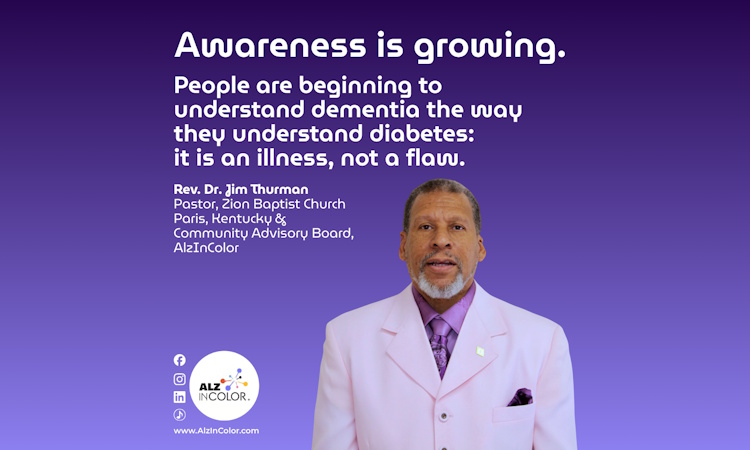
I've also watched stigma slowly shift. In Black and Latino communities, dementia has long been dismissed as normal aging, with inequities limiting access to information. I’ve long witness this myself. But awareness is growing — people are beginning to understand dementia the way they understand diabetes: it is an illness, not a flaw.
That understanding shapes my own life now. I stay mentally active. I think of my father dancing and mowing my lawn at 74, my grandmother sharp as a whip well into her nineties. And as I am now more aware of identifying possible early signs, I know the most important thing is to encourage evaluation — not ignore what we see.
If I were diagnosed myself, I would tell my family plainly: if I begin acting out of character, there is a reason. I would not want them shocked or hurt by what they don't understand. Knowledge gives families insight, and insight creates compassion.
Understanding changes everything. When we name what we’re facing, we can seek help, reduce stigma, and meet this disease with dignity, care, and faith with feet.
---
Rev. Dr. Jim Thurman is a member of the AlzInColor Community Advisory Board and is currently the pastor of Zion Baptist Church in Paris, Kentucky. He proudly represents a family legacy of military service. In recognition of his contributions, he was named Kentucky’s first statewide “Male Veteran of the Year” in 2014, honored in the U.S. Congressional Record, and inducted into the Kentucky Veterans Hall of Fame in 2016, where he now serves on the Board. He has dedicated his life to service—whether through his country, his church, or his tireless advocacy for veterans across Kentucky and beyond.