What My Grandmother’s Eyes Taught Me About Alzheimer’s
By Michelle Jackson, Ph.D.
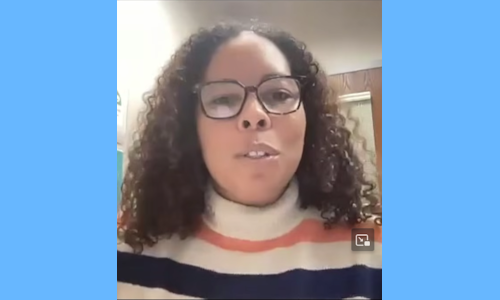
To view Michelle’s story on YouTube, click here.
The last time I saw my maternal grandmother before she passed, she could no longer talk or walk. I was young, and I didn’t have a name for what was happening to her. What I knew was that something was deeply wrong. But even in that silence, we could still reach other—through our eyes, through gospel songs she’d known her whole life, humming along when the words were gone. That was my first encounter with dementia. I just didn’t know it yet.
More than 15 years later, Alzheimer’s has become a normal part of my everyday life. As a nurse practitioner caring for older adults and a researcher focused on Alzheimer’s and related dementias in Black and Latino communities, it is woven into the fabric of everything I do. And still, I see how much we’re missing.
For too long, Alzheimer’s has been shaped in the public eye as a White person’s disease. The faces that appear in pamphlets, stories in the news, and even research participants in clinical trials look nothing like my grandmother or the other people I see everyday. Nor do they look like most of the families I sit with.
The reality is Black women carry the highest risk of developing Alzheimer’s and other related dementias compared to any other group. We—Black and Latino people—are in the center of this story, which is why we need access to the same resources and information other communities get readily.
It doesn’t help that we’ve been overlooked and even lied to by a healthcare system that has not always had our best interest at heart. The mistrust people have isn’t random, it was inherited. It shapes the way we show up at the doctor and whether we speak up when something feels off. So many of us suffer in silence, but advocating for yourself is not optional. If one provider isn’t listening, go to another and keep going until you find someone who listens.
I want people to understand that Alzheimer’s doesn’t always announce itself in the way we expect. We’re only taught to look for the dramatic signs. And while those matter, some of the earliest signs are quieter than that, things like a shift in mood or becoming more withdrawn. Depression is a known risk factor for Alzheimer’s and dementia, and I don’t think we give that nearly enough clinical attention. When I notice a patient becoming more reclusive, less engaged than they’ve been for years, I pay attention. That is the disease trying to tell us something.
Naming it early matters. When families catch it late, it narrows the window for everything. An early diagnosis doesn’t just open doors medically, it gives families time and the person living with the disease a voice in their own future.
These conversations shouldn’t only be happening in clinical settings. We need to normalize Alzheimer’s and dementia conversations. The cost of silence is too high. That’s why I believe AlzInColor is long overdue. It meets people where they are and tells the truth about who the disease actually affects. It gives our communities something we have rarely been offered when it comes to Alzheimer’s: the sense that this story belongs to us too.
---
Dr. Michelle Jackson is a nurse scientist, nurse practitioner, and Associate Professor at Point Loma Nazarene University. She serves as Research and Community Engagement Coordinator for the Black Women Inflammation and Tau Study (BWITS) at UC San Diego.